
The 8 Coefficients of Cannabis: How TOQidex Measures Your Experience
Strain names are unreliable. THC percentage tells one piece of the story. TOQidex uses 8 structured coefficients to turn your subjective cannabis experience into data that your personal prediction model can learn from.
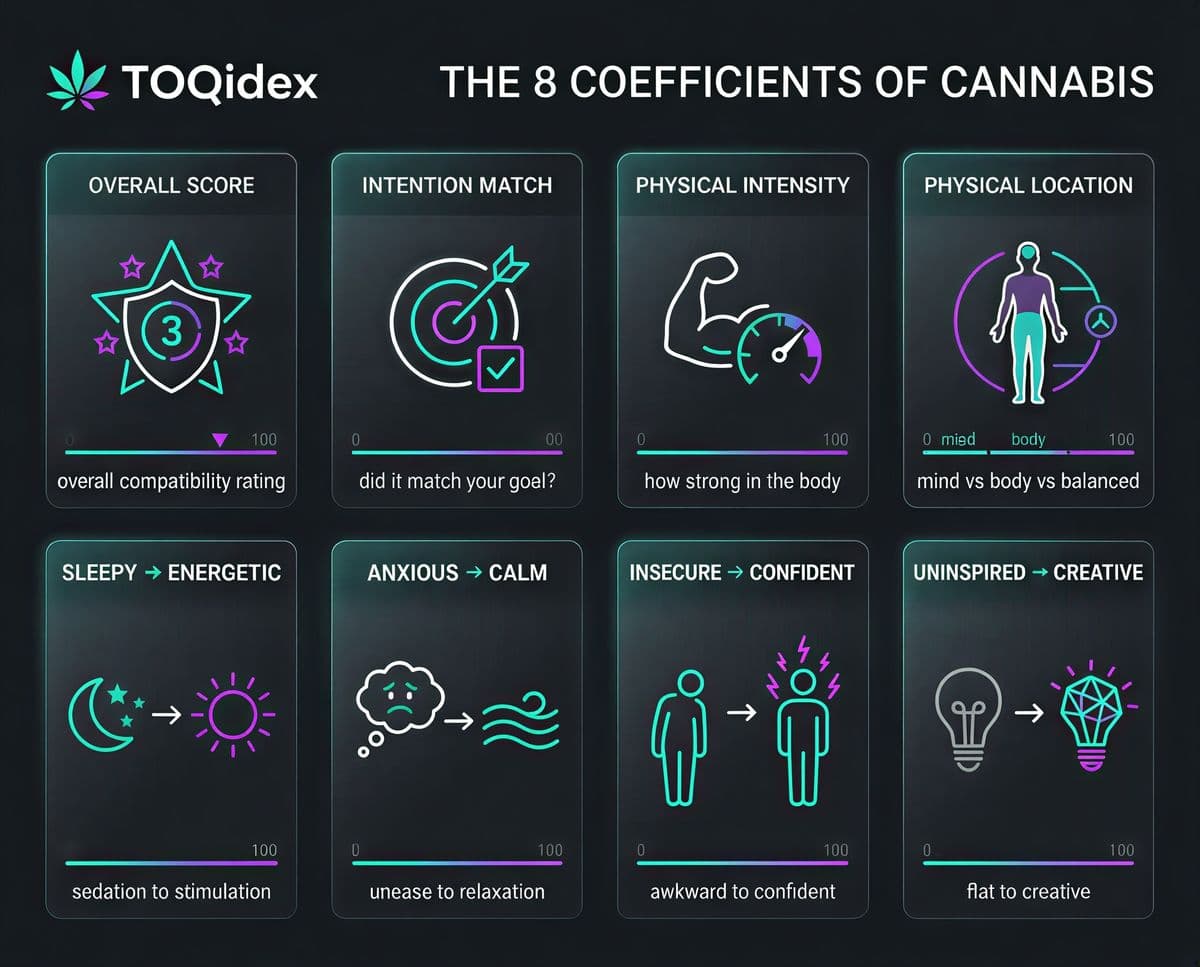
Every cannabis experience is multidimensional. A product might relax your body but cloud your mind. Another might elevate your mood but leave you too stimulated to sleep. Reducing these experiences to a star rating or a thumbs up/down loses the nuance that actually matters.
TOQidex uses 8 Coefficients of Cannabis to structure how you rate each product experience. These coefficients are the language your personal ML model learns from.
Why 8 Dimensions?
Research consistently shows that cannabis effects are multidimensional. A 2022 study analyzing 89,923 cannabis samples across six US states found that products cluster into distinct chemical profiles that produce different effect patterns (Smith et al., PLOS ONE, 2022). A single rating cannot capture these differences. Eight coefficients give your model enough signal to learn which chemical profiles produce which outcomes for you.
The 8 Coefficients
1. Overall Satisfaction
Your general assessment of the experience. This is the broadest signal and acts as the anchor for your model. It captures whether the overall experience was positive, neutral, or negative.
2. Intention Match
Did the product do what you intended it to do? A product that relaxes you when you wanted energy scores low on intention match even if the relaxation was pleasant. This coefficient teaches your model about your goals, not just your reactions.
3. Physical Intensity
How strong was the physical sensation? This ranges from barely perceptible to overwhelmingly strong. Products with the same THC percentage can produce very different physical intensities depending on their full chemical profile.
4. Mind / Body Balance
Where did the effect land on the spectrum between purely mental and purely physical? Some products produce a heady, cerebral experience. Others are felt primarily in the body. This coefficient helps your model differentiate products that look similar on paper but feel very different.
5. Sleepy / Energetic
From deeply sedating to wide-awake stimulation. This is one of the most practically important dimensions. Research suggests that terpene profiles, particularly myrcene concentration, may influence where a product falls on this spectrum (Sommano et al., Food Chemistry: Molecular Sciences, 2021).
6. Anxious / Calm
From heightened anxiety to deep calm. A 2024 Johns Hopkins clinical trial found that the terpene limonene significantly reduced THC-induced anxiety in a dose-dependent manner (Vandrey et al., Drug and Alcohol Dependence, 2024). This coefficient captures your personal anxiety-calm response, which varies significantly between individuals.
7. Insecure / Confident
From self-doubt to grounded confidence. Cannabis can affect social comfort and self-perception. This coefficient captures psychological effects that go beyond simple anxiety/calm, helping your model learn the more nuanced emotional territory.
8. Uninspired / Creative
From mental flatness to creative flow. Some users seek cannabis specifically for creative enhancement. This coefficient captures whether a product opened up creative thinking or produced mental fog.
How the Coefficients Power Predictions
After you log 10+ product experiences with these coefficients, TOQidex trains a personal ML model on your data. The model learns the relationship between a product's cannabinoid and terpene profile and your coefficient scores. When you encounter a new product, your model generates probability-based forecasts for how you might score it across all 8 dimensions.
Three model architectures are trained in parallel. TOQidex selects the best-performing one automatically. As you log more, predictions improve. You can track your model's confidence and version history for full transparency.
Why This Matters
The cannabis industry relies on strain names and THC percentages. Research shows both are unreliable predictors of experience. A study of 122 samples from 30 strains found only 4 strains maintained consistent genetic profiles across dispensaries (Schwabe & McGlaughlin, Journal of Cannabis Research, 2019). Another study found "no obvious segregation" between indica, sativa, and hybrid labels when mapped against actual terpene profiles (Smith et al., PLOS ONE, 2022).
The 8 Coefficients give you a standardized, structured language for your experience that maps directly to measurable chemistry. That is the foundation for prediction.
For a deeper look at the compounds your model tracks, read Cannabinoids and Terpenes: The Chemistry That Drives Your Cannabis Experience. To understand why we focus on chemistry instead of strain names, see Why Strain Names Are Unreliable.
Track Your Own Experience
TOQidex helps you build a personal evidence base by tracking your cannabis experience against real product chemistry.
Start Tracking FreeTOQidex tracks user-reported symptom response. It does not diagnose, treat, cure, or prevent any condition. All outputs reflect probability based on your personal logged data. This article is for informational purposes only and does not constitute medical advice.